By SocialStatsIQ Editorial Team
Why YouTube Views Divided by Impressions Does Not Match CTR
Understand why dividing total views by impressions produces a mathematically flawed CTR, how non-impression traffic skews ratios, and how to interpret true CTR.
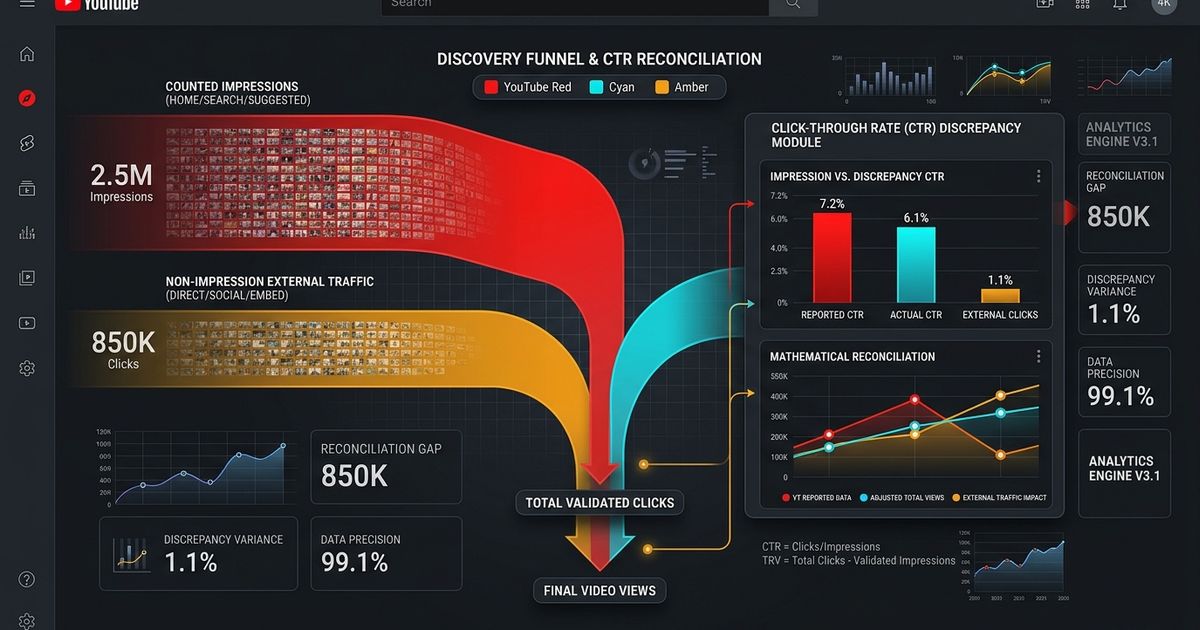
One of the most persistent troubleshooting queries in creator communities is the apparent mathematical bug in YouTube Studio: dividing total video views by counted impressions yields one percentage, while the official Impressions Click-Through Rate (CTR) reports a completely different number. Here is why that gap exists, how YouTube measures impressions, and how to audit your true thumbnail performance.
The Core Reason: You cannot divide Total Views by Impressions because not all views originate from a thumbnail impression. Embedded players, external links (Reddit, Twitter/X), notifications, end screens, and Shorts feed swipes register views without logging an impression. YouTube Studio CTR strictly measures Views from Counted Impressions ÷ Counted Impressions.
1. The Math: Studio CTR vs. The Intuitive Ratio
In YouTube Studio, the funnel card on the Reach tab isolates views into two distinct buckets: views generated by on-platform thumbnail discovery and views generated by non-impression channels:
- Official YouTube Studio CTR (%): (Views from Counted Impressions ÷ Counted Impressions) × 100
- Flawed Intuitive Ratio (%): (Total Views Across All Sources ÷ Counted Impressions) × 100
When you divide Total Views by Counted Impressions, the numerator contains views whose impressions are missing from the denominator. If a video receives significant traffic from Reddit or embedded blog articles, your apparent ratio could be 12% while your official Studio CTR is only 4.5%.
2. Counted Impressions vs. Non-Impression Traffic Sources
Under YouTube Help policy (answer 7628154), an impression is recorded only when a thumbnail is at least 50% visible on the user's screen for 1 second or longer on youtube.com or the native YouTube app:
| Traffic Source | Thumbnail Impression Logged? | Contributes to CTR Denominator? | Generates Video Views? |
|---|---|---|---|
| YouTube Search Results | Yes | Yes | Yes |
| YouTube Home Feed (Browse) | Yes | Yes | Yes |
| Suggested Videos / Up Next | Yes | Yes | Yes |
| External Websites & Social Links | No | No | Yes |
| Embedded Video Players | No | No | Yes |
| Direct URLs & Bookmarks | No | No | Yes |
| Mobile Push Notifications | No | No | Yes |
| End Screens & Interactive Cards | No | No | Yes |
3. Why CTR Naturally Compresses as Impressions Increase
Creators often panic when a video's CTR drops from 11% in its first two hours down to 4.8% by day three. They assume the thumbnail became stale or ineffective.
In algorithmic recommendation systems, CTR compression is the expected byproduct of success:
- Stage 1 (Core Cohort): During the first 1–6 hours, YouTube serves impressions to your most engaged subscribers and viewers who repeatedly watch your channel. CTR is artificially elevated (8% to 15%).
- Stage 2 (Algorithmic Testing): If high CTR is paired with solid retention (Average Percentage Viewed), YouTube tests the video on broader Browse features and Suggested shelves.
- Stage 3 (Audience Dilution): These new viewers have broader, less specific interests. Their click propensity is lower, so CTR drops to 4%–6%. However, because impression volume scaled from 1,000 to 100,000, total views surge.
To diagnose your traffic source breakdown and test sensitivity gains, use our free YouTube CTR Discrepancy Checker. You can also test your thumbnail packaging across dark and mobile feeds with the YouTube Thumbnail Preview.
4. What Is a "Good" YouTube CTR? Realistic Industry Benchmarks
According to YouTube Creator Academy, half of all channels and videos on YouTube have an impressions CTR that falls between 2% and 10%.
However, CTR should always be evaluated in context of impression volume:
- High CTR, Low Impressions (e.g. 14% CTR on 300 impressions): Excellent packaging for your core audience, but the algorithm has not yet found broad recommendation appeal.
- Moderate CTR, Massive Impressions (e.g. 4.5% CTR on 1,000,000 impressions): Outstanding algorithmic distribution delivering 45,000 views. A lower CTR on cold traffic is far more valuable than a high CTR restricted to subscribers.
5. Frequently Asked Questions
Why does dividing total views by impressions not equal my YouTube CTR?
YouTube Studio calculates Impressions Click-Through Rate strictly as: 100 × (Views from Impressions ÷ Counted Impressions). Total views include playbacks from external website embeds, direct URLs, end screens, notifications, and the mobile Shorts feed. Because none of these non-impression sources generate a thumbnail impression, dividing total views by impressions creates a mathematically mismatched denominator.
What qualifies as a counted YouTube thumbnail impression?
According to YouTube Help documentation, an impression is only counted when a thumbnail is at least 50% visible on-screen for 1 second or longer on youtube.com or the official YouTube mobile app. Impressions are logged on YouTube Search, Browse (Home feed), Suggested Videos, and Subscriptions.
Why does my CTR drop when a video gets recommended to more people?
Initial impressions are served to high-affinity subscribers who know your channel and click at high rates (8%–15%). When the algorithm expands distribution to colder, broader audiences across Browse and Suggested features, viewers are less familiar with your topic, naturally reducing aggregate CTR to 3%–6% while driving exponentially higher absolute views.
Is a 4% CTR bad on YouTube?
No. YouTube Creator Academy states that half of all channels and videos have an impressions CTR between 2% and 10%. A 4% CTR on 500,000 browse impressions indicates far broader reach and delivers 20,000 views, whereas a 12% CTR on 1,000 search impressions yields only 120 views. CTR must always be evaluated in the context of impression volume.