By SocialStatsIQ Editorial Team
Why YouTube RPM is Lower Than CPM: Ad Impressions, Monetized Playbacks, and 55% Split Breakdown
Wondering why your YouTube RPM is much lower than CPM? Learn the 55/45 split, monetized playbacks ratio, Premium revenue, and how to boost your RPM.
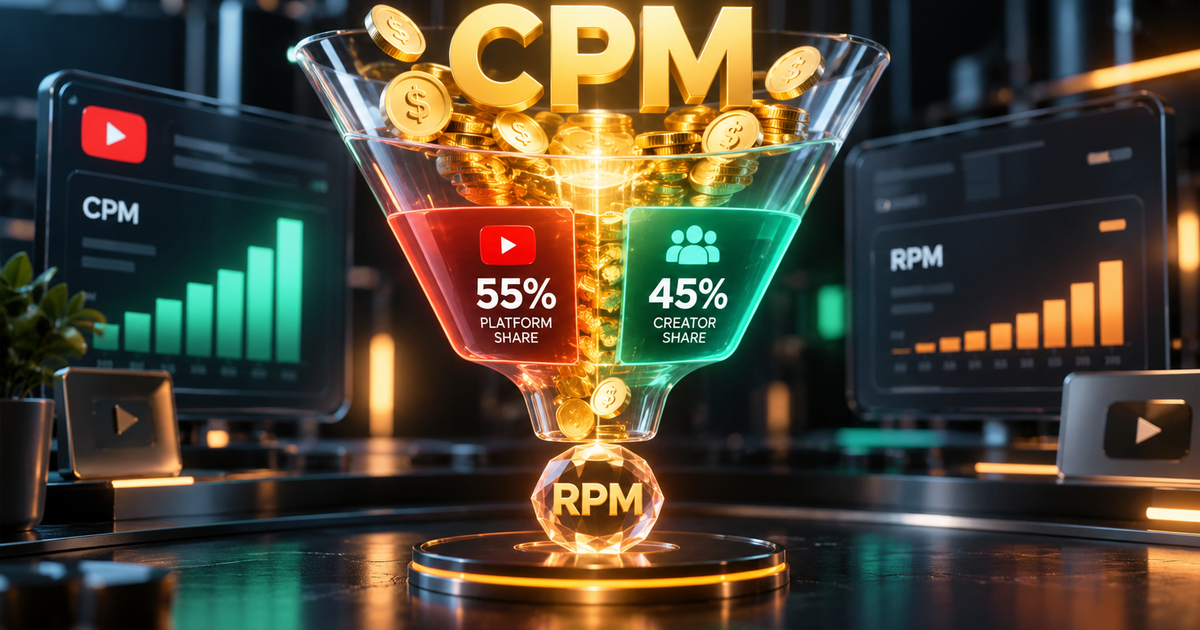
You open your YouTube Studio revenue tab and compare two critical metrics:
- Playback-based CPM: $16.50
- RPM (Revenue Per Mille): $4.80
Your heart sinks. You wonder: *Why is my RPM less than one-third of my CPM? Is YouTube taking hidden fees? Am I missing out on thousands of dollars in ad revenue?*
This disparity is the single most common point of confusion for newly monetized YouTube creators. CPM and RPM measure two completely different sides of YouTube's financial ecosystem:
- CPM measures what advertisers pay to YouTube per 1,000 ad impressions.
- RPM measures what you actually take home in your bank account per 1,000 total video views.
Understanding the mathematical bridges between CPM and RPM—including the 55/45 platform revenue split, monetized playbacks, ad block rates, and viewer geography—is essential to diagnosing your channel's true financial efficiency.
1. The Definitions: CPM vs. Playback CPM vs. RPM
To understand the math, you must distinguish between YouTube's three core monetization metrics:
| Metric | Full Name | Who It Measures | Formula / Meaning |
|---|---|---|---|
| CPM | Cost Per Mille (Impressions) | Advertisers | What an advertiser pays for 1,000 individual ad impressions |
| Playback-based CPM | Playback Cost Per Mille | Advertisers | What advertisers paid for 1,000 video playbacks that showed at least one ad |
| RPM | Revenue Per Mille (Views) | Creator | Total net revenue you earn per 1,000 total video views |
2. The Step-by-Step Math: How $16.50 CPM Becomes $4.80 RPM
The drop from a high CPM to your actual take-home RPM occurs across four mathematical filters:
Filter 1: The 55/45 Platform Split
Under the standard YouTube Partner Program terms for long-form video:
- Creator receives: 55% of net advertising revenue.
- YouTube retains: 45% to cover global server infrastructure, video hosting, bandwidth, and platform engineering.
- If an advertiser pays a Playback CPM of $16.50, your gross cut before accounting for non-monetized views is:
$$\$16.50 \times 0.55 = \$9.08$$
Filter 2: The Monetized Playbacks Ratio (The Real Culprit)
This is why RPM drops significantly: Not every view displays an ad.
In typical creator analytics, only 40% to 65% of your total views are "Monetized Playbacks." The remaining 35% to 60% of views show zero ads due to:
- Viewers using desktop AdBlockers or privacy browsers.
- Viewers watching on unsupported embedded players.
- YouTube's ad-frequency capping (preventing back-to-back ads for consecutive videos).
- Low advertiser bid inventory in specific geographic regions.
If your video receives 10,000 views, but only 5,000 of those views served an ad, your revenue is halved when spread across all 10,000 views.
Filter 3: YouTube Premium Subscriptions & Alternative Monetization
RPM includes more than just ad revenue. It is an all-inclusive metric calculated as:
$$\text{RPM} = \frac{\text{Ad Revenue} + \text{YouTube Premium} + \text{Memberships} + \text{Super Chats}}{\text{Total Views}} \times 1,000$$
YouTube Premium subscribers never see ads, so they generate $0.00 in traditional CPM. However, YouTube distributes a proportion of their monthly subscription fee to you based on how much time they spend watching your content, which feeds directly into your RPM.
3. Real-World Revenue Waterfall Example
To see how this works in practice, consider a gaming channel upload with 100,000 total views:
| Financial Step | Metric Value | Running Financial Total |
|---|---|---|
| Total Views | 100,000 views | 100,000 total viewers |
| Monetized Playbacks | 55% of views | 55,000 ad-eligible playbacks |
| Playback CPM | $14.00 per 1k | $770.00 Gross Advertiser Spend |
| YouTube Platform Cut (45%) | 45% retained by Google | -$346.50 retained by YouTube |
| Creator Ad Share (55%) | 55% net to creator | $423.50 Net Ad Revenue |
| YouTube Premium Revenue | Direct watch time pool | +$35.00 Premium earnings |
| Super Thanks / Tips | Fan funding | +$15.00 Fan support |
| Total Net Creator Earnings | Final monthly deposit | $473.50 Total Payout |
| Calculated Channel RPM | $(\$473.50 / 100,000) \times 1,000$ | $4.74 Actual Take-Home RPM |
4. Why Does Your Monetized Playback Rate Fluctuate?
If your RPM drops while CPM stays flat, your Monetized Playback percentage has declined. The primary reasons include:
- Audience Geographic Shifts: A viral video picking up views in Tier 3 countries (India, Philippines, Brazil) will dilute your average RPM, as ad inventory in those regions is lower than in Tier 1 countries (US, Canada, UK, Australia).
- Video Duration Under 8 Minutes: Videos under 8 minutes cannot run mid-roll ads. They are limited to a single pre-roll ad opportunity, slashing the monetized playback density compared to 12-minute uploads with manual mid-rolls.
- Desktop vs. Mobile Viewership: Desktop audiences utilize ad-blocking extensions at a rate of 25% to 40%, whereas mobile app viewers rarely have ad blockers installed.
5. How to Increase Your YouTube RPM
To close the gap between your CPM and RPM, focus on actionable levers you can control:
- Optimize for Mid-Roll Ads: Ensure videos are over 8 minutes long and place manual ad breaks at logical 3-to-4-minute intervals. This creates multiple monetized playback opportunities within a single viewer session.
- Target High-Intent Search Topics: Tutorial and software reviews attract commercial advertisers willing to bid higher CPMs, directly elevating your baseline RPM.
- Encourage YouTube Premium Viewers: Long-form, high-retention content generates substantial payouts from YouTube Premium watch time pools without relying on ads.
- Promote Channel Memberships: Adding native fan funding directly increases your RPM formula numerator without requiring more ad impressions.
6. Frequently Asked Questions (PAA)
Why is my RPM so much lower than my CPM on YouTube?
RPM is lower than CPM because CPM measures the gross amount advertisers pay for 1,000 ad impressions before YouTube takes its 45% revenue cut. Furthermore, RPM divides your net earnings across all total video views, including the 35% to 60% of views where viewers used ad blockers or where no ads were served.
What is a good RPM on YouTube?
A good RPM depends on your content niche and audience geography. In gaming or vlogging, an RPM of $2.00 to $4.00 is typical. In high-value niches such as finance, SaaS, business, and real estate with US-based audiences, RPMs routinely exceed $12.00 to $25.00 per 1,000 views.
How much does YouTube take from ad revenue?
Under the YouTube Partner Program, YouTube takes 45% of net advertising revenue on long-form videos, paying the creator 55%. For YouTube Shorts, the split is reversed: creators share a 45% pool of allocated ad revenue, with YouTube retaining 55%.
What is the difference between CPM and Playback-based CPM?
CPM measures the cost per 1,000 individual ad impressions (which counts multiple ads if a viewer watches two pre-rolls). Playback-based CPM measures the cost per 1,000 video views where at least one ad was displayed, providing a cleaner look at viewer monetization value.